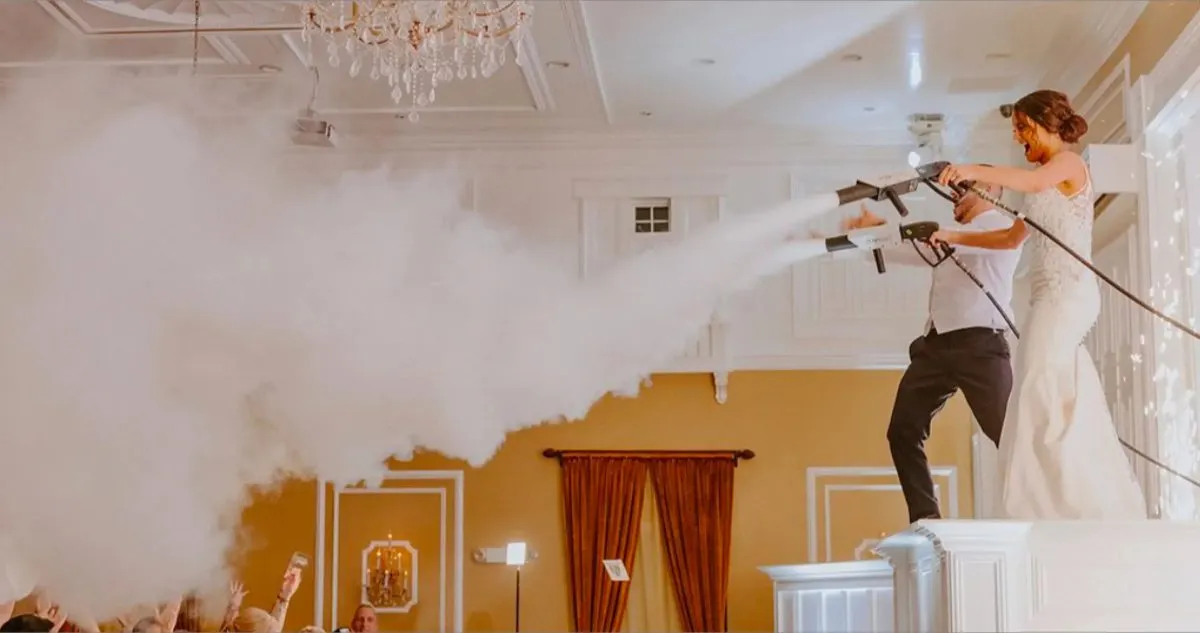
CO2 cannons produce one of the most visceral effects in live event production: a sudden blast of dense white fog shooting several feet into the air with a loud hiss, gone in seconds. Used well, it’s the exclamation point on a dance floor at exactly its peak energy. Used poorly, or in the wrong venue, it’s a fire alarm activation, a soaked ceiling tile, or a room full of confused guests wondering what just happened. The difference almost always comes down to venue conditions and timing, not the equipment itself.
How CO2 Cannons Actually Work
Liquid carbon dioxide is stored under pressure in a cylinder. When triggered, it’s released through a nozzle and expands rapidly, causing a temperature drop that condenses ambient moisture into a dense, fast-dissipating fog cloud. Unlike haze machines, which use oil or water-based fluid to create a lingering atmospheric effect, CO2 cannons are a burst effect, loud, cold, and gone within 5 to 10 seconds. There’s no residual haze hanging in the room afterward.
This matters because the two effects get confused constantly. Haze is subtle and continuous, used to make lighting beams visible in the air. CO2 is a one-time, high-impact blast meant to be felt as much as seen.
Where CO2 Cannons Genuinely Work
The best use case is a single, well-timed burst tied to a specific musical or emotional peak: the drop in a high-energy song, the moment the couple is announced onto the dance floor, or a big reveal at a corporate event. It’s a tool for punctuation, not atmosphere. Fired more than once or twice in a night, the effect loses its impact and starts to feel gimmicky rather than exciting.
It works especially well in:
- Open, high-ceiling venues where the fog has room to disperse without pooling near guests or setting off overly sensitive smoke detection.
- Industrial and warehouse-style spaces, which are increasingly popular for Baltimore and DC-area receptions, where the aesthetic already leans toward bold, high-energy production.
- Late-night dance sets when the crowd is already engaged and looking for a peak moment rather than during dinner or toasts when a loud blast would be jarring.
Where It Backfires
Smoke detectors. This is the single biggest risk. CO2 fog is dense enough that it can trigger photoelectric smoke detectors in venues without a fire-effect exemption or a properly bypassed system for the event. A triggered alarm doesn’t just embarrass everyone, it can mean an automatic fire department response, an evacuation, and in some venues a hefty false-alarm fine charged directly to the client. Any venue being considered for a CO2 effect needs to confirm in advance whether detectors in that specific room can be temporarily covered or bypassed by venue staff or building engineering, and get that in writing.
Low ceilings. In a room with an 8 to 10 foot ceiling, the fog has nowhere to go and will roll back down onto the crowd and dinner tables, which can be startling for guests who weren’t expecting it, and unpleasant if it settles near food.
Sound sensitivity. The discharge is loud, closer to a sharp hiss than a bang, but it’s still enough to startle guests, particularly older relatives or young children who don’t know it’s coming. We generally recommend it only after the room has shifted fully into dance-floor mode, not during a moment where surprise could read as alarming rather than exciting.
Cost of cylinders. Each blast uses a meaningful amount of CO2, and multiple bursts across the night require carrying and prepping multiple tanks, which adds cost and logistics that aren’t always worth it for the diminishing marginal excitement of a third or fourth blast.
Venue Conversations Worth Having
Before booking a CO2 effect, ask your venue:
- Are there photoelectric smoke detectors in the reception space, and can they be covered or temporarily disabled by venue staff during the event?
- Is there a fire watch requirement for effects like this, similar to what’s often required for cold spark or open flame?
- Has this venue allowed CO2 effects before, and if so, where were the cannons positioned?
Some of the newer event spaces built out in converted Baltimore warehouses and industrial venues around Frederick have already worked through these questions with other production companies and have a known process. Older hotel ballrooms in Northern Virginia and DC are more likely to have strict, non-negotiable fire code requirements that make CO2 a non-starter without significant advance coordination.
Cylinder Logistics and Handling
CO2 cannons run on pressurized tanks that are heavier and bulkier than most people expect, and transporting, securing, and refilling them is its own piece of production logistics. Tanks need to be strapped upright and secured during transport, kept away from direct heat sources, and handled by someone trained on the regulator and nozzle assembly, since a poorly seated fitting can cause a leak or an uncontrolled discharge. For a wedding with two units firing a single synchronized burst, that typically means at least two full-size tanks on site plus a spare, since discharge volume and pressure drop off tank to tank and a partially spent cylinder can produce a noticeably weaker blast than a fresh one.
Positioning for Maximum Effect and Minimum Risk
Cannon placement affects both how the moment looks in photos and how safe it is. Units are typically positioned flanking the dance floor or a stage, angled up and slightly outward so the plume reads clearly in photos without firing directly over guests’ heads. Keeping a minimum clearance from tables, drapery, and any exposed wiring or lighting fixtures matters, since the fog is cold and can affect nearby electronics if a unit is placed too close. We also think about camera and phone sightlines during placement; a beautifully timed blast that’s blocked by a DJ booth or a pillar in half the room loses most of its impact for guests not standing in the right spot.
Alternatives Worth Considering
If a venue won’t allow CO2 because of detector sensitivity or ceiling height, a few effects can deliver a similar “moment” without the same risk profile:
- Confetti or streamer cannons, which create a visual burst without any fog or smoke detection risk, though they do require cleanup coordination with the venue.
- A strobe and blackout cue, dropping all lighting to black for a beat before flooding the floor with strobes and full color on the next downbeat, which can hit almost as hard emotionally with zero fire code exposure.
- Cold spark fountains, appropriate where ceiling height allows and the venue has approved heat-based effects, discussed in more detail in a separate piece on cold spark approval.
Building It Into the Timeline
Because a CO2 blast is such a short, singular moment, it needs an actual cue in your event timeline rather than a vague “sometime during dancing” plan. We ask couples and event hosts to identify the specific song, or the specific moment in a song, they want it tied to, and we rehearse that cue with the DJ or bandleader ahead of time so the trigger happens on the beat rather than a beat late. A blast that fires a half-second after the drop instead of on it reads as off, even if most guests couldn’t articulate why.
Bottom Line
A CO2 cannon is a fantastic tool in the right room, at the right moment, with the right advance conversation with your venue. It’s a liability in the wrong one. The equipment doesn’t fail, the planning does, almost every time an event runs into trouble with this effect.
If you want a big moment on your dance floor and aren’t sure whether your venue can support it, Solender Events will check the room’s fire detection setup and ceiling height before ever recommending it, so you get the effect without the surprise fire truck.