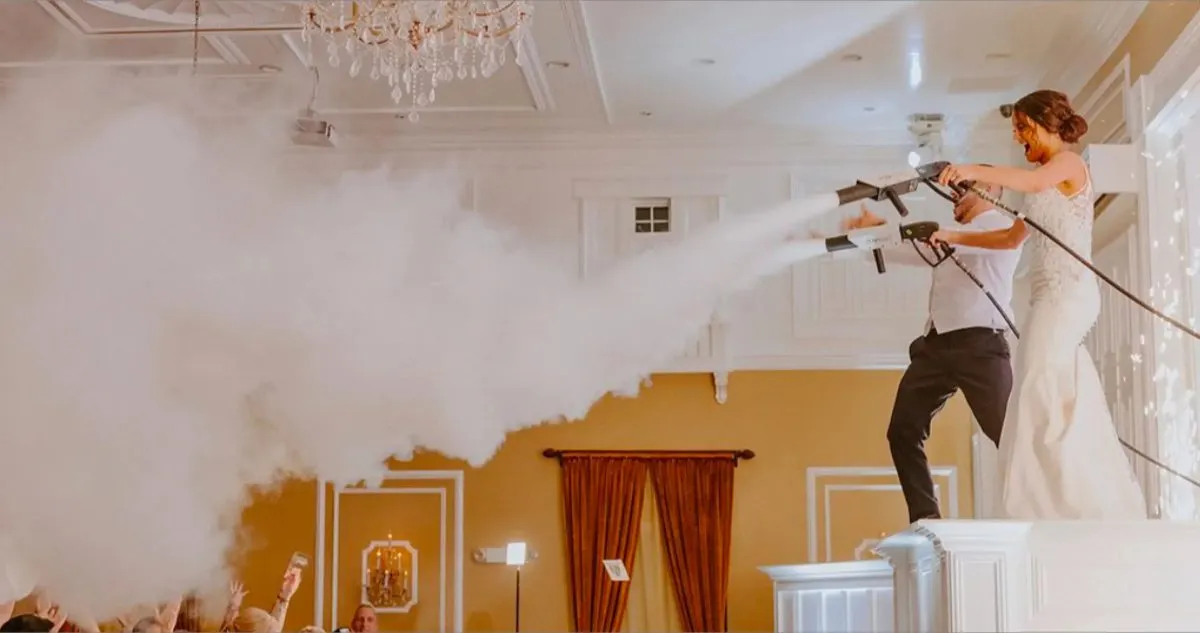
Cold spark fountains are one of the most requested effects we get asked about, usually because someone saw a video online of a couple’s grand entrance or first dance framed by two columns of shimmering gold sparks shooting toward the ceiling. It’s a genuinely dramatic effect. It’s also one of the most misunderstood, because “cold spark” gets lumped in with pyrotechnics, fireworks and fire effects in people’s minds, when it’s a fundamentally different technology with its own rules.
What a Cold Spark Machine Actually Does
A cold spark fountain heats a specialized granulated material, typically titanium-based, to a temperature that causes it to eject as glowing particles. The word “cold” is relative: the sparks themselves are far cooler than a firework’s spark and burn out within a second or two of leaving the machine, and they produce no smoke, no odor, and no open flame at the source. That’s the key distinction fire marshals and venues care about, there’s no combustion of gas or explosive charge, and the machine itself doesn’t create fire risk the way pyrotechnics do.
That said, “cold” doesn’t mean harmless. The sparks are still hot enough to mark or singe fabric, hair, and skin at close range, and the machines themselves get warm during operation. This is why every reputable production company treats cold spark placement, distance from guests, and machine handling with the same seriousness as any live effect.
Why Venues Still Say No Sometimes
Even though cold sparks aren’t classified as pyrotechnics under most fire codes, many historic venues in DC and older properties throughout Maryland and Virginia have blanket policies against any spark, flame, or smoke effect regardless of the underlying technology, because their insurance policies or lease terms with the building owner don’t distinguish between effect types. Some rowhouse-era DC venues with wood-paneled interiors and older sprinkler systems are particularly cautious, and understandably so.
Before you fall in love with the idea of a cold spark entrance, ask your venue coordinator these questions directly:
- Do you allow cold spark or “cold pyro” effects specifically, not just fireworks?
- Is there a minimum ceiling height requirement (most venues and machine manufacturers recommend at least 13 to 16 feet of clearance)?
- Does the local fire marshal require a permit or a site inspection, and how far in advance does that need to be filed?
- Is there a required fire watch or extinguisher on hand during use?
The Permitting Reality Across the DMV
Requirements vary by jurisdiction, and this is one area where we strongly recommend working with a production company that has already run cold sparks in your specific venue or county. Some Virginia counties and Maryland jurisdictions require a licensed operator or a permit filed with the local fire marshal’s office regardless of whether the effect technically counts as pyrotechnics, simply because it involves heat-based effects indoors. DC venues, especially historic ones, tend to be the strictest, and it’s common for a beautiful rowhouse mansion or embassy-adjacent venue to flatly prohibit any spark effect no matter what paperwork you bring.
Outdoor tented events, common on Eastern Shore farms and Loudoun County estates, generally have more flexibility, but tent fabric proximity, hay bales, dry grass, and drape all become factors in where machines can be placed.
Placement and Setup Considerations
Getting approval is only half the job. Getting the effect to look right and stay safe requires real planning:
- Ceiling clearance. Sparks travel upward several feet depending on the machine’s power setting. A room with low chandeliers or exposed sprinkler heads needs machines dialed down or repositioned.
- Distance from guests and drape. Machines are typically placed at least 8 to 10 feet from the nearest guest table, dance floor edge, or fabric backdrop, with output angled away from seating.
- Floor protection. Spent particles fall as fine ash. We put down protective mats or floor covering under and around each machine to avoid marking hardwood, marble, or rented dance floors.
- Timing and remote triggering. Most events use a DMX-triggered or remote-fired cue so the machines fire in sync with the grand entrance music or the first dance’s final chorus, rather than being started manually and hoping the timing lines up.
What It Looks Like in Practice
The most common use we see is framing a grand entrance or a first dance finale: two units flanking the couple, firing a burst of sparks as they enter or as the song builds. It reads beautifully in photo and video because the shimmer catches light and creates a natural frame around the couple without smoke obscuring their faces, which is a real advantage cold spark has over haze-based effects in photography.
We also see it used sparingly at corporate galas for a product reveal or an award announcement, where the visual punctuation works even in a room full of people who see effects like this regularly.
The Operator’s Role
Because cold spark units are electrically triggered heating elements rather than simple plug-and-play accessories, they should be run by someone trained specifically on that model of machine, not handed off to a general AV tech unfamiliar with its quirks. A trained operator checks the granulated fuel load before the event, confirms the unit reaches proper operating temperature well ahead of the cue rather than firing cold or underpowered, and stays positioned near the machines throughout the event in case of a malfunction or an unexpected guest wandering too close. Some jurisdictions formally require a certified operator on-site for the duration of the effect; even where it’s not legally required, it’s good practice.
What Happens During a Fire Marshal Site Visit
For venues or jurisdictions that require a pre-event inspection, a fire marshal visit typically involves confirming machine placement relative to combustible materials, checking that a fire extinguisher of the appropriate class is staged nearby, and sometimes requesting a live test firing during the walkthrough. Scheduling this visit requires lead time, often two to four weeks depending on the jurisdiction’s inspection calendar, so this is not something to request the week before the wedding. If your venue has hosted cold spark effects before, ask whether they have documentation from a previous inspection that can speed up the process for your date.
Working Around a Venue That Says No
If your dream venue prohibits cold sparks outright and won’t budge, it’s worth having a backup plan rather than abandoning the moment entirely. Some couples move the effect outdoors immediately after the reception, in a courtyard or parking area where the venue’s indoor restrictions don’t apply, coordinated with photography and videography to still capture the moment even though it’s separated from the main event flow. Others substitute a different effect discussed elsewhere, like a confetti cannon or a choreographed lighting and strobe cue, that delivers a comparable visual impact without the fire code exposure.
Budgeting for It
Cold spark packages typically run in the $400 to $900 range depending on the number of machines, the venue’s permitting requirements, and whether a fire watch attendant is mandated by local code. Venues that require a certificate of insurance naming them specifically, or a fire marshal site visit, will add both cost and lead time, so this is not an effect to decide on two weeks before your wedding.
Getting It Approved Without the Headache
The smoothest path is getting your venue’s answer in writing early, then handing that information to your production team so they can handle permitting, insurance paperwork, and fire marshal coordination directly rather than you chasing three departments on your own.
If you’re picturing a spark-framed entrance for your wedding or gala anywhere in Maryland, DC or Virginia, Solender Events can tell you honestly whether your venue will allow it and handle the approval process so you’re not left guessing two weeks out.