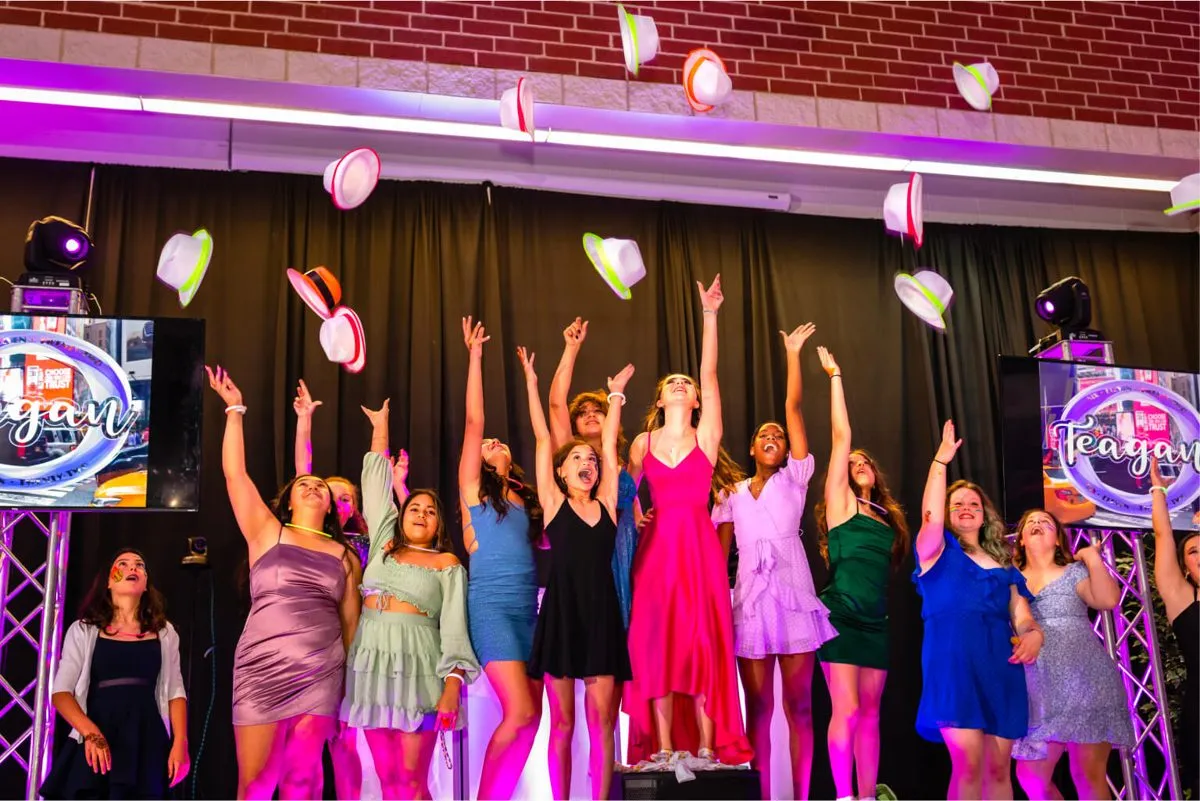
Every bar and bat mitzvah reception has a built-in tension: the mitzvah child’s friends want nonstop games and loud music, and the parents’ generation came for a nice dinner, a good playlist, and time to actually talk to each other. Neither group is wrong to want what they want, and the reception’s success largely comes down to how well the night is sequenced to serve both without either group feeling ignored.
Why This Gets Harder as Guest Lists Grow
At a smaller mitzvah, say, under 100 total guests, the kid and adult groups naturally overlap more, since fewer tables means adults are closer to the dance floor and more inclined to join in. At a 200-plus guest mitzvah with a large ballroom, the physical distance between the adult dinner tables and the kid-heavy dance floor can be substantial, and that distance makes energy management a real logistical problem rather than just a vibe issue.
Build the Timeline Around Alternating Energy
The single most effective tool is alternating, not blending. Trying to play music and run games that satisfy both a room of forty-something parents and a room of thirteen-year-olds at the exact same moment usually satisfies neither. Instead, a well-built timeline moves between:
- High-energy kid segments, current music, games, motivator-led dancing, aimed squarely at the tween crowd
- Adult-friendly stretches, during dinner courses especially, music that skews toward songs adults actually want to hear and can talk over, at a volume where conversation is still possible
- Crossover moments, a horah or family circle dance, a song most generations know, or a game that pulls in parents and grandparents alongside kids, which are some of the best moments of the night precisely because they bridge the two groups
A DJ who’s mapped this rhythm into your specific timeline, rather than just playing a continuous top-40 set, will produce a night that reads as high-energy from both perspectives instead of exhausting for one side.
Physical Layout Matters More Than People Expect
If your venue allows any flexibility in floor plan, consider:
- Placing a lounge or gaming area (cornhole, arcade-style games, a photo booth) near the dance floor but distinct from it, so kids who need a break from dancing have somewhere to go that isn’t back at the adult tables
- Keeping the bar and cocktail area far enough from the dance floor speakers that adults can order a drink and have a conversation without shouting
- If budget allows, a separate kids’ lounge space during cocktail hour keeps early arrivals from feeling awkward while adults handle their own cocktail hour flow
Volume Is a Bigger Lever Than Families Realize
One of the simplest, most underused tools is adjusting sound levels by moment rather than running one flat volume all night. Dinner and cocktail hour segments should sit at a level where people at a table of ten can hear each other. Dance segments can go louder. Experienced DJs handle this dynamically rather than setting one volume for the whole event, and it’s worth asking your DJ company directly whether they actively manage volume by segment.
Giving Kids Real Ownership of Part of the Night
Kids engage more when some part of the party clearly belongs to them, a themed lounge area, a specific game segment introduced as “for the mitzvah crew,” or simply a DJ and motivator team who talk directly to them rather than over them. Conversely, giving adults a clear signal that certain stretches (dinner, toasts, quieter dancing later) are their moment helps the whole room feel intentionally designed rather than chaotic.
The Motivator’s Role in Bridging Both Groups
Motivators are typically focused on the kid dance floor, but a good team also knows how to pull hesitant parents and grandparents into a crossover moment without making it feel forced. A horah, in particular, works well as a genuine bridge, it’s a moment where multiple generations participate together, rooted in tradition rather than trend, and it tends to be one of the most photographed parts of the whole reception.
Managing the Room When the Two Crowds Have Very Different Energy Ceilings
Sometimes the adult crowd at a mitzvah is genuinely more reserved, content to stay seated and talk through most of the reception, while the kid crowd wants nonstop movement. Other times it flips: parents who grew up going to mitzvahs themselves want to be on the floor as much as their kids do. Neither pattern is a problem on its own, but a DJ and planning team need to know which version your family is heading into so the timeline reflects it rather than assuming a generic 50/50 split. Ask yourselves honestly, based on past family events or your own friend group, whether your adult guests tend to dance or tend to watch, and pass that read along during planning.
Coordinating Catering Timing With Entertainment Timing
One of the more overlooked levers in balancing these two audiences is syncing the catering team’s course timing with the entertainment timeline. If dinner service runs long while the DJ has already shifted into high-energy kid music, you end up with adults trying to eat through a loud dance set, which satisfies nobody. A short pre-event call between your DJ, planner, and catering captain to confirm roughly when each course will be served lets the entertainment team hold back the loudest segments until plates are cleared, rather than guessing.
Handling the Awkward Middle Stretch
Almost every mitzvah reception has one point, usually forty-five minutes to an hour in, where the kid energy has peaked once and dipped, adults are mid-meal, and the room can feel like it’s stalling. This is normal and predictable, not a sign anything has gone wrong. Experienced DJs plan for this stretch specifically, often with a lower-key interactive segment, a trivia game about the mitzvah child that both generations can enjoy, or a brief video or slideshow moment that gives everyone a shared focal point without demanding anyone be on their feet.
What to Communicate to Your DJ Company in Advance
- Your actual kid-to-adult guest ratio, not just total headcount
- Whether grandparents or older relatives are a significant part of your guest list, since that changes music choices during crossover moments
- Any specific concerns, a kid group that’s especially shy, or an adult group that tends to leave early, both change how a timeline should be paced
- Whether you want a dedicated kids’ lounge or activity area built into the floor plan
- Roughly when catering plans to serve each course, so entertainment segments can be built around it rather than against it
Bottom Line
A great mitzvah reception isn’t one that picks a side between “kid party” and “adult party”, it’s one that runs both simultaneously through smart sequencing, layout and volume management. The families who get this right almost always got there by being specific with their vendors about their actual guest mix rather than assuming a generic timeline would sort itself out.
Solender Events, parent company of Maryland’s DJ and Epic Events, builds mitzvah timelines around each family’s real guest mix across Maryland, DC and Northern Virginia, let’s talk through your guest list and room before your date.