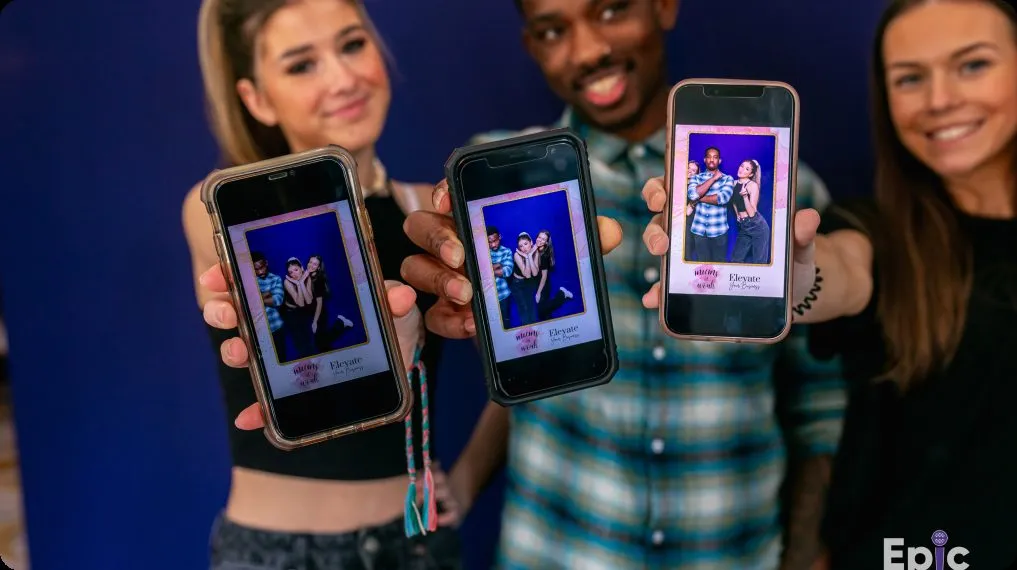
A photo booth at a corporate event or trade show can be pure entertainment, or it can be a functioning piece of your marketing plan. The difference comes down to a handful of deliberate choices about branding, format, and what happens to the content after guests walk away. Here’s how we approach branded photo activations for corporate clients across the DMV.
Start With the Goal, Not the Format
Before choosing a booth type, get clear on what the activation is actually supposed to accomplish. A booth meant to drive booth traffic and lead capture at a trade show needs a very different setup than one meant to generate shareable social content for a company anniversary party, or one meant simply to entertain employees at a holiday event with no marketing objective at all.
Common corporate goals include:
- Driving foot traffic to a trade show booth
- Capturing leads or email addresses in exchange for a printed or digital photo
- Generating branded social media content with a hashtag for organic reach
- Producing a polished internal keepsake for an employee event or anniversary
Each of these points toward a different booth format and delivery method, so this decision should come before backdrop design or prop selection.
Green Screen: The Most Flexible Branding Tool
Green screen setups are the workhorse of corporate activations because the same physical setup can produce dozens of different branded backgrounds without rebuilding anything on-site. A single booth can place attendees in front of a company’s product imagery, a themed graphic tied to a conference session, or a branded step-and-repeat, simply by swapping the composited background between sessions or even between guests.
This is especially useful for trade shows running multiple sessions or themes throughout a single event, since the backdrop can change without any physical setup change on the show floor.
Open-Air Print Booths With Branded Overlays
For events where a physical takeaway matters, company milestones, employee appreciation events, product launches, an open-air print booth with a custom-designed print border or overlay carrying the company logo, event name, and date turns every printed photo into a piece of branded collateral that leaves the venue with each attendee.
Step-and-repeat backdrops printed with a repeating logo pattern reinforce this further, ensuring that even background elements of a shared social photo carry brand visibility.
Digital Delivery and Hashtag Campaigns
If organic social reach is the goal, digital-first formats, GIF booths, boomerang booths, or straightforward digital photo delivery via text or QR code, tend to outperform physical prints, since content only spreads once it’s shared online. Building a dedicated event hashtag into every digital overlay, and encouraging attendees to post directly from the booth’s delivery screen, meaningfully increases the volume of organic content generated during the event.
A shareable online gallery, branded with the event name and accessible via a QR code at the booth, also gives attendees an easy way to find and share their photos after the event ends, extending the activation’s reach beyond the day itself.
Lead Capture Without Killing the Fun
For trade show environments where lead capture is a genuine business objective, the most effective setups collect contact information as part of the natural flow of using the booth, an email address entered to receive a digital photo, for example, rather than as a separate, disconnected form. Attendees are far more likely to complete a lead capture step when it’s the mechanism for receiving something they already want (their photo) rather than an unrelated ask.
It’s worth discussing data handling and any compliance requirements with your marketing team ahead of time, since captured contact information typically needs to route into existing CRM or lead management systems rather than living solely with the booth vendor.
Booth Placement on a Trade Show Floor
Placement drives participation more than almost any other variable. A booth tucked at the back of a booth space gets a fraction of the traffic of one positioned near a main aisle or high-traffic intersection. If your goal is driving traffic to a specific booth location, position the activation close enough to create a visible line that passersby notice, without blocking the aisle itself.
Booth attendants who actively invite passing attendees, rather than waiting for people to notice the setup on their own, also meaningfully increase participation compared to a purely self-serve setup.
Designing the Branded Overlay Itself
The overlay or template design is where a lot of activations quietly underperform. A logo crammed into a corner alongside a busy background pattern reads as cluttered in a photo people are actually going to share. The overlays that perform best tend to keep the logo, hashtag, and event name in a clean, consistent placement, usually along one edge or the bottom third of the frame, so the guest’s face and pose remain the visual focus. It’s worth asking your design team or vendor for a mockup using a real sample photo, not just a blank template, before finalizing, since text and logo placement that looks balanced on an empty template can crowd an actual photo once a person or group is standing in frame.
Integrating the Booth Into the Broader Event Flow
A branded activation performs best when it’s woven into the rest of the event program rather than treated as a standalone station. That can mean having the emcee or stage host mention the booth and hashtag from the main stage between sessions, placing signage with the hashtag near registration and at other high-traffic points, or timing a specific themed backdrop change to coincide with a keynote or product announcement so the activation content lines up with what’s being discussed elsewhere in the event. Coordinating with the event’s AV and program team in advance ensures the booth gets these natural promotional moments instead of relying purely on foot traffic to discover it.
Staffing and Brand Representation
Corporate activations benefit from attendants who understand they’re representing the client’s brand, not just running equipment. Clear, professional communication, comfort with light lead-capture conversation, and familiarity with the day’s messaging all matter more here than at a purely social event like a birthday party. It’s worth discussing staffing expectations directly with your vendor rather than assuming a standard booth attendant will handle brand messaging on their own.
Measuring Results
Because branded activations are meant to serve a marketing purpose, it’s worth building in a way to measure their performance:
- Hashtag volume and reach, tracked through social listening if organic content was the goal
- Leads captured, cross-referenced against booth traffic counts if lead generation was the objective
- Gallery views and downloads, if a shareable online gallery was part of the activation
- Print counts, as a simple proxy for total engagement at physical events
Sharing these numbers with your vendor after the event also helps refine placement, staffing, and format choices for future activations.
Multi-Day and Multi-Session Events
For conferences and trade shows that run multiple days or feature several distinct sessions, it’s worth planning the activation’s content plan day by day rather than using one static backdrop for the entire event. Swapping a background or overlay to reflect a new day’s theme, a different sponsor spotlight, or a specific breakout track keeps returning attendees engaged instead of walking past a booth they already photographed on day one. This is one of the clearest advantages of a green screen setup over a fixed physical backdrop, since the change requires no physical rebuild between sessions.
Budget Considerations
Branded activations typically involve custom design work (overlays, step-and-repeats, digital templates) in addition to standard booth rental costs, so budgeting should account for both the equipment and the design and branding production separately. Costs scale with the complexity of custom branding, the number of hours staffed, and whether lead capture integration is required, so it’s worth scoping these details clearly with your vendor well ahead of the event date.
Getting Started
A branded photo activation works best when it’s planned as part of the broader event marketing strategy rather than bolted on as an afterthought entertainment item. Solender Events works with corporate clients across Maryland, DC and Virginia to design activations, from trade show lead capture to branded employee event keepsakes, that support the actual business goals behind the event, not just the entertainment budget line.