After thousands of events across the DMV, we’ve learned that “photo booth” means seven different things to seven different clients. Someone booking a corporate trade show wants something completely different than someone booking a bat mitzvah. Here’s how the formats actually compare, so you can stop guessing and pick the right one for your room, your crowd, and your budget.
Open-Air Print Booth
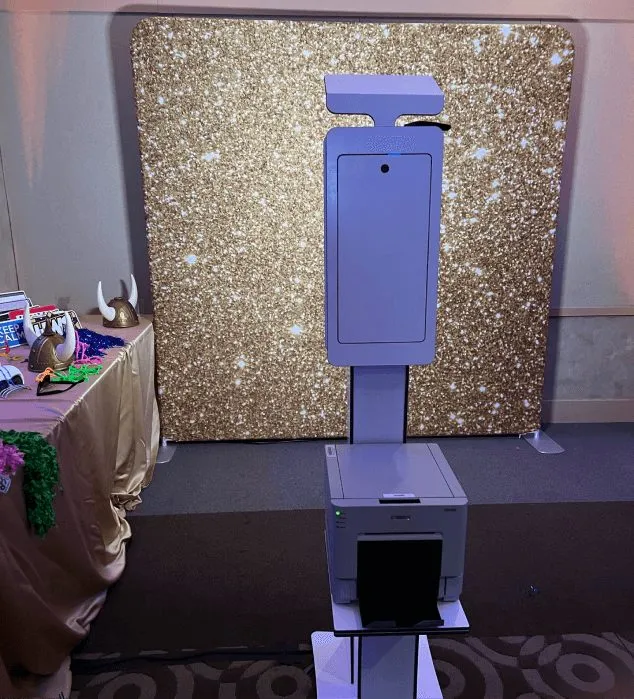
This is the workhorse. No enclosure, no curtain, just a camera, a stand, professional lighting, and a backdrop behind guests. It fits more people in a shot than an enclosed booth ever could, it photographs well against custom backdrops or step-and-repeats, and it prints in seconds on the spot.
Best for: weddings, sweet sixteens, corporate parties, and any event where you want a physical print guests can hold that night. Groups of 8-10 fit comfortably, which matters at weddings where whole tables want in.
360 Video Booth
Guests stand on a small platform while a camera arm spins around them, capturing a slow-motion video from every angle. It requires more floor space (generally an 8x8 to 10x10 footprint) and a bit of guest coaching, but it consistently draws the longest line at any event we staff.
Best for: sweet sixteens, quinceaneras, milestone birthdays, and any crowd under 40 that lives on social media. It’s less ideal for older or more reserved guest lists who may feel self-conscious performing for a spinning camera.
Green Screen / Virtual Background
A green backdrop lets us composite guests into any scene digitally, a step-and-repeat, a branded set, a themed backdrop, without physically building it. It’s the most flexible format for corporate branding because the same hardware can produce dozens of different looks depending on the client’s needs that week.
Best for: corporate activations, trade shows, and themed parties where the “location” matters more than the physical setup. It’s a poor fit if your priority is a tactile print guests can frame, since the final image only looks right once composited.
Roaming Handheld Booth
An attendant walks the room with a camera and a compact portable printer, catching candid moments during cocktail hour instead of waiting for guests to find a booth. There’s no line, no dead space, and it captures the guests who never would have walked over to a fixed booth.
Best for: cocktail hours, receptions with tight floor plans, and events where you don’t want to sacrifice square footage to a booth setup. It produces fewer posed group shots than a stationary print booth, so many clients pair the two.
Glam Black-and-White Booth
Editorial-style lighting, usually a ring light or beauty dish, produces black-and-white or moody portraits that look like they came from a magazine shoot rather than a party favor. The pace is slower since each guest or pair gets a genuine mini portrait session.
Best for: milestone anniversaries, black-tie galas, and adult-skewing events where the aesthetic matters as much as the fun factor. It’s not the best choice for large families or big groups since it’s built around one or two subjects at a time.
Digital Experience / GIF and Boomerang Booth
This format skips the printer entirely and delivers animated GIFs, boomerangs, or video loops straight to guests’ phones via text or a shareable gallery link. Setup is fast, there’s no paper cost, and content is built to be shared immediately on social media.
Best for: younger crowds, brand activations, and events where a hashtag gallery matters more than a physical keepsake. Skip it if your guest list skews older or if a printed memento is the whole point of the booth.
Mosaic Photo Wall
Guests take individual photos throughout the night that automatically assemble into one giant image, often the couple’s portrait, a company logo, or an event graphic, made up of hundreds of tiny guest photos. It’s part activity, part decor, and part keepsake that gets more impressive as the night goes on.
Best for: weddings and milestone events with 100+ guests, where the finished mosaic becomes a takeaway gift for the guest of honor. Smaller guest counts won’t fill out the mosaic in time to see the reveal.
Space, Power and Placement Considerations
Every format has physical requirements that get overlooked until setup day. Open-air print booths need roughly a 10x10 area including backdrop, camera distance, and a small guest queue. 360 booths need a taller ceiling clearance than most people expect, since the camera arm swings overhead, and a level floor since the platform needs to sit flush. Mosaic walls need a stable, visible spot near the main action so guests remember to stop by throughout the night rather than only at the start. All formats need a dedicated power circuit, and roaming booths are the only format that can operate without a fixed footprint at all, which makes them the default choice for venues with genuinely tight floor plans, common in many historic DC rowhouse event spaces and smaller Old Town Alexandria venues.
Staffing: What a Good Attendant Actually Does
It’s easy to assume any booth format works the same regardless of who is running it, but attendant quality changes the guest experience more than people expect. A good attendant keeps the line moving, coaches nervous guests through a 360 booth spin so the footage doesn’t look stiff, manages prop chaos so it doesn’t become its own bottleneck, and handles the technical hiccups, a jammed printer, a low battery, a guest who deletes their own photo by accident, without guests ever noticing there was a problem. For corporate and brand activations in particular, staffing also means someone comfortable representing the client’s brand voice, not just operating the camera.
Turnaround Time and Delivery
How quickly guests get their content also varies by format. Print booths deliver instantly, guests walk away with a physical print in under a minute. Digital and GIF booths typically deliver within seconds via text message, assuming reliable venue cell signal, which is worth testing in advance at rural or historic venues with poor reception. Mosaic walls have the longest turnaround by design, since the final reveal only happens once enough guest photos have been collected, usually late in the event. Green screen composites can be delivered instantly if the backgrounds are pre-loaded, or take longer if custom compositing happens after the event, which is worth clarifying with your vendor if a fast turnaround matters for same-night social sharing.
How to Actually Choose
Start with three questions:
- Who is your guest list? A room full of teenagers wants the 360 booth. A room full of grandparents wants the print booth or glam booth.
- What do you want people to walk away with? A physical print, a phone full of shareable video, or a group keepsake for the guest of honor all point to different formats.
- How much floor space do you actually have? Roaming booths need zero footprint. 360 booths and mosaic walls need real square footage and should be planned into the floor plan early, not squeezed in at the last minute.
Most of our larger weddings and milestone events end up combining two formats, a print booth for tabletop favors and a roaming photographer for cocktail hour, or a 360 booth for the dance floor crowd and a glam booth in a quieter corner for family portraits. There’s no rule that says you have to pick just one.
Budget Ranges to Expect
Pricing varies by hours booked, attendant staffing, prop packages, and add-ons like custom overlays or a mosaic keepsake canvas, but as a general framework in the DMV market: open-air print booths and roaming booths tend to run on the lower end of the photo booth spectrum, 360 booths and mosaic walls sit in the middle to upper range given the equipment and space involved, and glam booths price closer to a portrait session given the staffing and lighting setup. Always ask for a detailed quote rather than relying on a headline number, since hours, prints, and staffing all move the price.
If you’re not sure which format fits your venue, guest list, or vision, that’s a conversation worth having before you book anything. Solender Events runs all seven formats throughout Maryland, DC and Virginia, and we’re happy to walk through your event details and recommend what will actually get used on the night.