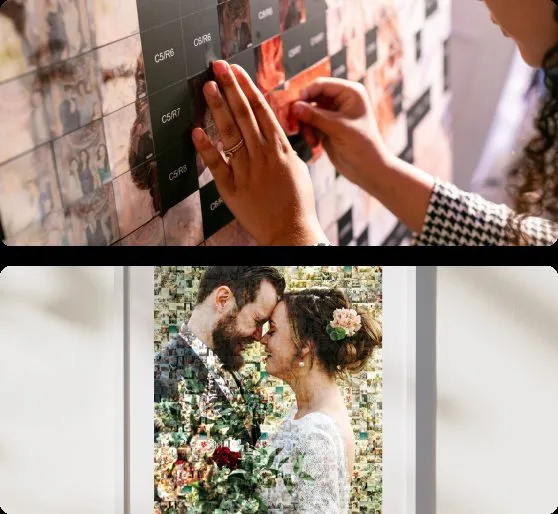
A mosaic photo wall does something no other photo booth format does: it turns individual guest photos into pieces of one larger image, revealed gradually over the course of the event until, by the end of the night, hundreds of small guest photos have assembled into a portrait, logo, or graphic. It’s part activity, part decor, and part takeaway gift, and it’s one of the more genuinely surprising formats once guests understand what they’re building toward.
How It Actually Works
Guests step up to a booth station throughout the event and take a quick photo, usually a simple headshot or small group shot. Software automatically places that photo into a predetermined position within a larger grid, and as more guests participate, the grid fills in. Viewed up close, it’s just individual snapshots; viewed from a distance, or once complete, those snapshots resolve into a single larger image, most often a couple’s engagement portrait, a company logo, or a custom graphic chosen ahead of time.
The wall is usually displayed on a large screen or printed as a physical mosaic canvas at the end of the night, so the finished piece becomes a keepsake the guest of honor keeps long after the event.
Why It Needs a Real Guest Count
This format lives or dies on volume. A mosaic grid might be built from anywhere between a few hundred and over a thousand individual guest photos depending on the size and resolution chosen, and it needs enough participation to actually fill in and reveal the underlying image before the night ends. At smaller events, under roughly 75-100 guests, the mosaic often won’t fill quickly enough for guests to see the payoff, and the experience falls flat.
This is why we typically recommend a mosaic wall for larger weddings, milestone celebrations, and corporate events with substantial headcounts, rather than intimate gatherings where a print or glam booth will get more genuine use per guest.
If your guest count is on the borderline, there are a couple of workarounds worth discussing with your vendor: reducing the total tile count in the grid so fewer photos are needed to complete it, or allowing repeat visits from the same guests throughout the night so participation isn’t capped at one photo per person.
The Reveal Is the Moment That Matters
Unlike a print booth, where the “prize” happens the instant each guest takes their photo, a mosaic wall’s biggest moment is collective and delayed: the full reveal, often timed to a specific point in the night, a wedding’s final dance, a company’s anniversary toast, or the end of a gala. That timing should be planned deliberately with your DJ or emcee rather than left to happen organically, since a mosaic that quietly finishes in a corner with no announcement wastes the format’s best feature.
Many hosts choose to unveil the completed mosaic on a large screen with a brief announcement, which also gives the guest of honor a natural moment to react to seeing themselves, or the couple, assembled from their own guests’ faces.
If the mosaic isn’t likely to reach full completion by the planned reveal time given your guest count and event pace, ask your vendor about a “reveal at current progress” option instead, showing the piece as far as it’s gotten rather than an empty promise of a full reveal that never quite finishes.
Choosing the Final Image
The underlying image is chosen ahead of time and matters more than most people initially think:
- Weddings: A couple’s engagement photo or a simple portrait taken specifically for the mosaic tends to work best; high-contrast images with clear facial features resolve more clearly at a distance than busy, detailed photos.
- Corporate events: A company logo, anniversary number, or event graphic keeps the branding message intact even when viewed from a distance before it’s fully complete.
- Milestone birthdays or anniversaries: A recent portrait of the guest of honor, rather than an old photo, creates a stronger emotional payoff at the reveal.
Simpler images with strong contrast and clear shapes resolve far better in mosaic form than intricate or low-contrast photos, so it’s worth taking guidance from your photo booth vendor on what will actually read well once broken into hundreds of tiles.
Space and Setup Needs
A mosaic wall setup includes a photo station (similar footprint to a standard print booth) plus a large display screen or monitor positioned where guests can watch the mosaic build throughout the night. Venues with a natural focal wall, near the entrance, by the bar, or facing the dance floor, tend to work best, since visibility drives participation. If guests can’t see the mosaic building, they’re less likely to seek out the photo station repeatedly.
Screen size scales with room size. A monitor that reads clearly in a small reception space can be nearly invisible from the back tables of a large ballroom, so confirm screen size against your actual room dimensions rather than assuming a standard display will work everywhere.
Encouraging Participation Throughout the Night
Because the mosaic depends on steady participation over several hours rather than one concentrated rush, it helps to have your DJ or emcee mention it periodically, not just once at the start of the night. A quick reminder during a lull in dancing or right after dinner service, “swing by the mosaic wall before the big reveal,” keeps the photo count climbing instead of stalling out after the first hour of interest fades.
Pairing With Other Formats
A mosaic wall works well as a background activity that runs continuously through an event rather than a single-focus attraction, which makes it easy to pair with a livelier format like a 360 booth or roaming photographer without competing for the same moment or the same line. Guests can pop over to the mosaic station between other activities throughout the night rather than treating it as a one-time stop.
What to Expect on Cost and Delivery
Because a mosaic wall involves both a photo capture station and a larger display and software setup, pricing tends to land in the middle-to-upper range of photo booth formats, and often includes the option of a printed physical canvas of the finished mosaic as a takeaway gift, which is usually priced as an add-on. Confirm with your vendor whether the finished mosaic file is delivered digitally as well, so the couple or company can reproduce it beyond the physical canvas if they choose.
Is It Right for Your Event?
If your guest count is large enough to fill the grid, and you have a natural moment in your timeline to reveal the finished piece, a mosaic wall produces one of the more memorable keepsakes of any booth format, because the guest of honor doesn’t just get a photo of the event, they get a portrait built out of the people who were there.
Solender Events can help you figure out whether your guest count and venue layout make sense for a mosaic wall, and how to time the reveal so it actually lands.