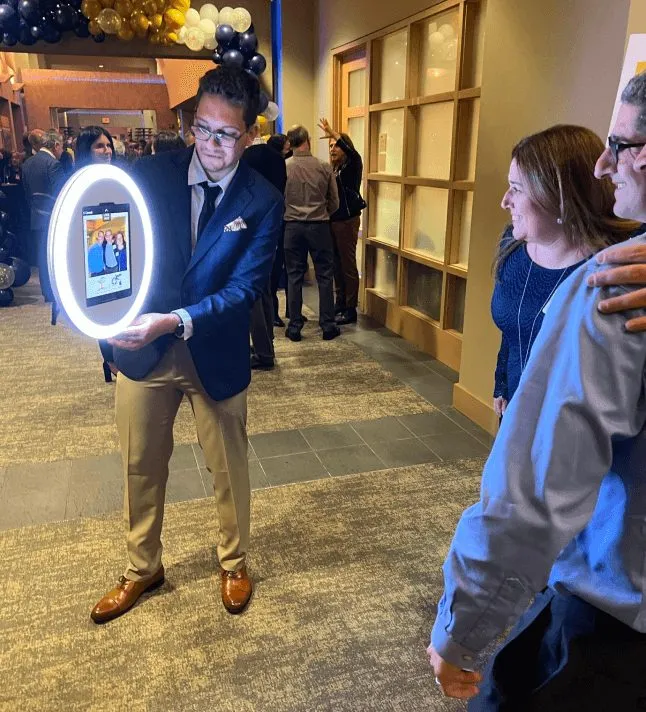
Cocktail hour is usually 60 minutes, sometimes less. Guests are mingling, finding their seats, catching up with people they haven’t seen since the last wedding. It’s the most candid, socially loose part of the entire event, and it’s also the window where a static photo booth performs worst. Here’s why a roaming booth is almost always the better call for this specific stretch of time.
The Problem With a Fixed Booth During Cocktail Hour
A stationary booth requires guests to notice it, walk over, and choose to stop what they’re doing to use it. During cocktail hour, most guests are doing exactly the thing they came to do, talking, drinking, catching up, and a booth tucked in a corner competes for attention it usually loses. By the time people finish appetizers and drinks, the hour’s often over and the booth sat half-used.
There’s also a physical space problem. Cocktail hour rooms are often smaller than the main reception space, sometimes a foyer, terrace, or bar area, and a full booth setup with backdrop and stand can eat up real estate that’s better used for high-tops and bar lines.
What a Roaming Booth Does Differently
A roaming, or handheld, booth puts an attendant directly into the crowd with a camera and a compact portable printer. Instead of waiting for guests to come to it, it goes to them, catching genuine conversations, candid laughs, and small groups exactly as they’re forming, without asking anyone to pose against a backdrop.
This matters because cocktail hour photography works best candid. Nobody wants to interrupt a conversation to walk to a booth; they’re happy to have their photo taken where they’re already standing, especially when the print lands in their hand within seconds.
No Line, No Dead Time
Because there’s no fixed station, there’s no line to form and no dead time waiting for the booth to free up. A roaming attendant can capture 15-20 unique moments in the time a static booth would process 4-5 guests waiting their turn, simply because there’s no queue to manage.
This is especially valuable at weddings with 100+ guests, where a static booth line during a one-hour cocktail hour would only reach a fraction of the room before dinner is called.
It Captures the Guests Who Never Use a Booth
Every event has a segment of guests who will never walk up to a photo booth on their own, older relatives, more reserved guests, people deep in conversation who don’t want to break away. A roaming attendant reaches these people because the interaction is brief, low-commitment, and happens wherever they already are. That’s often the difference between a gallery that reflects your whole guest list and one that only reflects the people who sought out the booth.
What You Lose Compared to a Static Booth
Roaming booths trade some things for that flexibility. Posed group shots of eight or ten people are harder to coordinate on the move than at a fixed backdrop, and there’s no consistent backdrop across every print, since the “background” is whatever’s behind the guest in the room. If a cohesive, on-brand backdrop across every photo matters to you, that’s a real trade-off worth knowing about going in.
The Case for Running Both
Most of our weddings and corporate events don’t choose one over the other, they run a roaming booth during cocktail hour and a static print or 360 booth once the reception or dance floor portion begins. That sequencing plays to each format’s strength: roaming catches the candid, high-mingling window, and the static booth catches the group shots and higher-energy moments once guests have settled in and are actively looking for something fun to do.
How Roaming Attendants Actually Move Through a Room
A skilled roaming attendant doesn’t wander randomly, they work the room with a rough mental map: bar lines, high-top clusters, the edges where quieter guests tend to gather, and any scenic spot a venue offers, like a terrace view, a fireplace, or a well-lit garden corner. They aim for continuous movement rather than lingering too long in one area, since the goal is breadth of coverage across the entire guest list rather than an exhaustive set of shots from one corner of the room. Good attendants also read body language quickly, approaching an open, laughing group very differently than a pair having a quieter one-on-one conversation, and knowing when to skip a moment entirely rather than intrude.
Weather and Outdoor Cocktail Hours
A lot of DMV cocktail hours happen outdoors, on a terrace, lawn, or rooftop, especially during the spring and fall shoulder seasons when weather cooperates. Roaming booths handle this far better than static setups, since there’s no backdrop or stand to secure against wind, and the attendant can simply move indoors quickly if weather shifts without any equipment teardown. If your cocktail hour has an outdoor component with an indoor backup plan, mention this specifically when booking, since it affects what gear the attendant brings and how they plan their route through the space.
Practical Considerations for Booking a Roaming Booth
- Staffing: Roaming booths need an attendant who’s comfortable approaching strangers and keeping the pace brisk; this is as much a hosting skill as a photography one.
- Printer logistics: Portable printers used for roaming setups produce smaller prints than a full booth setup, which is normal and expected, but worth knowing if you want a specific print size.
- Venue flow: Let your roaming attendant know the layout in advance, bar locations, photo-worthy backdrops like a building facade or garden, and any areas that are off-limits, so they can move through the space efficiently.
- Digital delivery: Ask whether roaming shots are also uploaded to a shareable online gallery in addition to the physical print, since many guests will want a digital copy along with the print they walk away with.
Budget Considerations
Roaming booths typically require less specialized equipment than a 360 booth or mosaic wall, so pricing tends to sit toward the lower-to-middle range of photo booth options, with the main cost driver being attendant hours rather than hardware. Booking one for just the cocktail hour, rather than the full event, is a common and cost-effective way to add coverage without committing to a full-night rental.
If your cocktail hour is short and your guest list is large, a roaming booth is usually the better use of that hour than a static setup. Solender Events can help you decide whether to run roaming alone or pair it with a second booth format for the rest of your event.