Every wedding DJ proposal in the DMV includes a list of enhancements. Uplighting. Dance floor lighting. A monogram. Cold sparks. A photo booth. A 360 booth. Dancing on a cloud. It reads like a menu at a diner, and most couples have no idea which items change the night and which ones just change the invoice.
We have worked more than twenty thousand events across Maryland, Washington DC and Virginia, and we can tell you plainly: a few of these enhancements transform a room, a few of them create the single most photographed moment of the night, and a few of them are genuinely optional depending on your venue. Here is the honest breakdown.
Uplighting: the highest-impact dollar you will spend
If you only add one thing to a DJ package, add uplighting. It is not close.
A hotel ballroom at Bethesda North Marriott, a Loudoun County winery barn and a Baltimore museum atrium all have one thing in common when the sun goes down: the house lighting was designed for conferences, not celebrations. It is flat, it is usually a slightly green fluorescent, and it makes your flowers, your linens and your guests all look duller than they are.
Uplighting fixes that in about forty-five minutes of setup. We place battery-powered wireless fixtures around the perimeter, wash the walls in a color pulled from your palette, and the room stops looking like a rental and starts looking like a designed space.
A few things worth knowing:
- Sixteen to twenty-four fixtures covers most ballrooms. Small restaurant buyouts can look great with twelve. Big tents sometimes need forty.
- Warm amber during dinner is a nearly universal winner. It reads as candlelight in photos and it flatters every skin tone in the room.
- Color changes matter. The same fixtures can be amber for dinner, your accent color for toasts, and dynamic during dancing. Ask whether that programming is included or extra.
- Wireless is not a luxury. Cabled uplights mean gaffer tape across your venue floor. Battery fixtures avoid that entirely, and most historic DC venues strongly prefer them.
Dance floor lighting: the difference between a party and a dark corner
Uplighting sets the mood for the whole room. Dance floor lighting is what makes people feel like they are somewhere, instead of dancing in a well-lit dining space.
The mistake we see from inexperienced DJs is treating dance floor lighting as an on/off switch, a couple of moving heads blasting random patterns all night long. Done well, it is programmed in stages. Almost nothing during dinner. A soft wash during the first dance. Movement and color when the floor opens. Full energy during the peak hour. A different look entirely for the last song.
Ask your DJ how the lighting is programmed, not how many fixtures come in the package. The number is far less important than whether anyone is running it.
Custom monogram: pretty, but be strategic
A gobo monogram projects your initials, your names or a wedding date onto a wall or the dance floor. It costs modestly, it photographs nicely, and it is genuinely a lovely touch.
The catch is placement. Projected on a busy patterned wall, it disappears. Projected onto a dance floor, it gets walked on within twenty minutes. The best spots are a clean wall behind the head table, the back wall of the room, or an exterior surface visible through windows.
If your venue has a clean projection surface, do it. If it does not, spend that money on more uplights.
Cold sparks: the grand entrance moment
Cold spark fountains produce a fifteen-foot column of sparks that looks like pyrotechnics but runs far cooler. They are indoor-safe at most venues, though you always need approval from the venue and sometimes the fire marshal.
Where they earn their cost:
- The grand entrance. Two fountains framing the doors as you walk in is a genuinely dramatic image, and every guest films it.
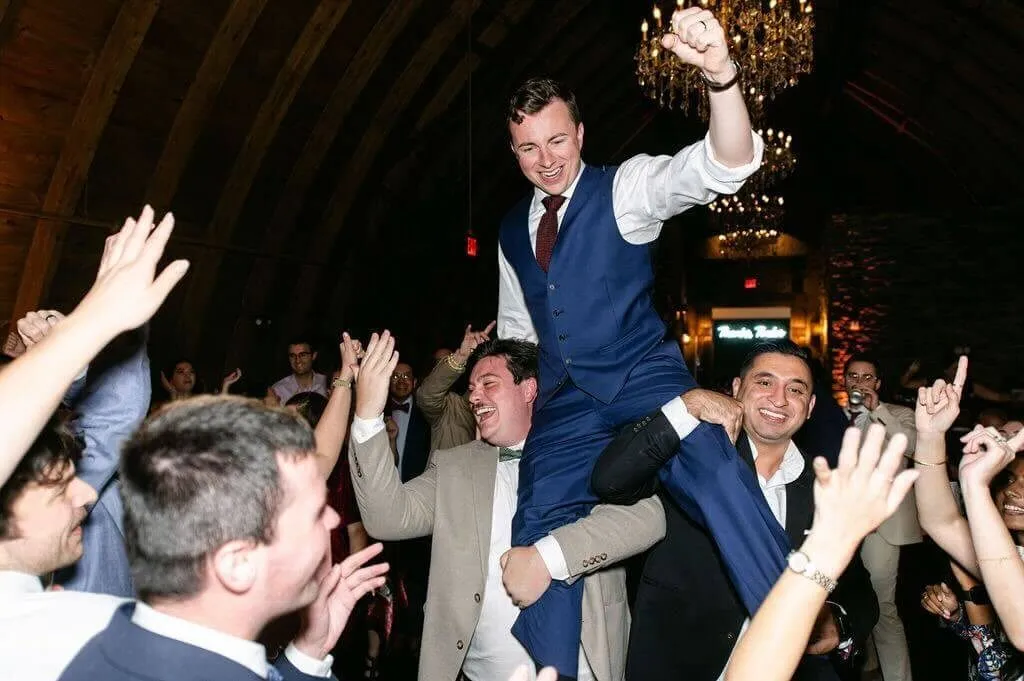
- The hora lift at a Jewish wedding.
- The last song, timed to the final chorus.
What they do not do is improve a night that lacks energy. Sparks punctuate a party; they do not create one. Book a DJ who can fill a floor first, then add sparks to the moments that deserve them.
CO2 cannons: energy, not decoration
A CO2 cannon fires a burst of cold fog straight up over the dance floor. It does two things: it spikes the crowd’s energy at a beat drop, and it physically cools a packed floor, which at a July wedding in Maryland is not a minor benefit.
CO2 is a young-crowd enhancement. At a mitzvah, it is close to essential. At a wedding with a lot of guests over sixty, it can feel jarring unless your DJ uses it sparingly and warns the room. Discuss it honestly with your DJ instead of buying it because it looked cool on Instagram.
Dancing on a cloud: the first-dance photo
Low-lying fog made from dry ice hugs the floor and makes a first dance look like it is happening on a cloud. It looks incredible in photos, it lasts about four minutes, and unlike haze, it will not trigger smoke detectors.
This is a single-moment enhancement. If your photographer is skilled and you care about first-dance images, it is worth it. If you are not planning a formal first dance, skip it.
Photo booths: the enhancement with the longest tail
Every other enhancement on this list affects the night. A photo booth affects the following ten years, because guests keep the prints.
The DMV’s most popular booth types:
- Print booth. Open-air, instant strips, forty-plus backdrops. The classic, and still the one that generates the most keepsakes.
- 360 video booth. The highest-shared option. Guests post clips before they even leave the room.
- Glam booth. Black-and-white beauty lighting. Perfect for black-tie weddings and galas.
- Roaming booth. A host circulating with a handheld rig. Best for cocktail hour and for venues with no floor space to spare.
- Mosaic wall. Every photo becomes a tile in a mural that builds all night.
If your guest list skews younger, the 360 booth will dominate. If it skews older or more formal, the print or glam booth will get far more use. Many of our couples book a print booth for the reception and add a roaming host for cocktail hour.
Ceremony sound: not an enhancement, a requirement
We list this last because it is not really optional, and yet it is the item couples most often try to cut.
If your ceremony is outdoors, or in a separate space from your reception, you need a dedicated ceremony system. That means a speaker at the ceremony site, a lavalier on the officiant, a handheld for readings, and backup transmitters on separate frequencies. The DC area is crowded with wireless traffic, and frequency coordination is real work.
Every wedding where guests complain that they could not hear the vows is a wedding where somebody tried to move one speaker from the reception space and hope for the best. Do not be that wedding.
How to prioritize if your budget is finite
Most couples cannot buy everything. Here is the order we would spend in, assuming a standard reception:
- A DJ and MC who can genuinely read a room. Everything else is decoration on top of this.
- Dedicated ceremony sound, if the ceremony is separate or outdoors.
- Uplighting, sized to your venue.
- Dance floor lighting with real programming.
- A photo booth matched to your crowd.
- One signature effect, sparks at the entrance, or a cloud for the first dance. One, not all of them.
- A monogram, if you have a clean surface for it.
Ask these questions before you sign
Whatever you book, get clarity on the mechanics:
- Who is physically running the lighting during the reception?
- Are uplights battery powered, and is color programming included?
- Does the venue allow sparks, haze and dry ice, and who secures that approval?
- Is the photo booth attended, and are prints unlimited?
- What is the setup window, and does your contract include the labor?
- Is there backup gear on site?
Any DJ company worth hiring will answer all seven without hesitating.
The DMV angle
A few regional realities shape these decisions. Historic DC venues frequently ban haze and limit load-in windows. Loudoun County wine country and Frederick farm venues are outdoor-first, which makes power planning and weather backups more important than any effect. Eastern Shore weekends in Easton and St. Michaels are usually multi-day, so enhancements often get spread across a welcome party, the wedding and a farewell brunch. Baltimore’s industrial spaces have gorgeous bones that uplighting reveals rather than hides.
Whoever you hire should know your specific venue, or should be willing to walk it with you before finalizing the plan. We do that at no cost for every wedding we book, because the site visit is what turns a package list into an actual design.