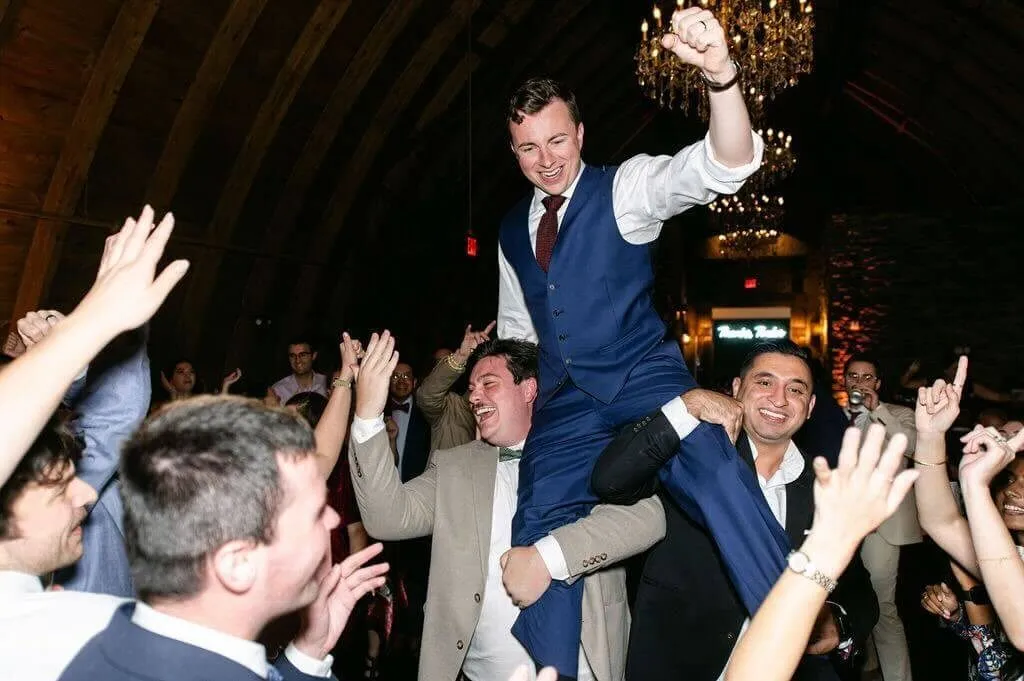
Couples planning a wedding in Bethesda, Rockville, Old Town Alexandria or out on the Eastern Shore usually start their DJ search the same way: they look at Instagram reels of packed dance floors and assume the gear and the playlist are the whole job. They are not. After thirty years and thousands of receptions across Maryland, DC and Virginia, the truth is simple: the DJ’s judgment during the live moments of your night matters more than their equipment list. These are the questions that get you past the sales pitch and into that judgment.
1. Will you actually be my DJ, or will I meet someone else on the wedding day?
Some companies book a sales rep or owner for the consultation, then send whichever DJ is free that Saturday. That is not automatically bad, but you need to know it up front. Ask directly who will be at your reception, when you will meet them, and whether that is guaranteed in the contract.
2. How many weddings have you personally performed as the DJ, not just booked?
There is a real difference between a company that has done thousands of events and an individual DJ who started three months ago. Both can be fine, but you should know which one you are hiring, especially for a venue like Chesapeake Bay Beach Club or Lansdowne Resort where tent power, tides, and outdoor timing all add wrinkles a rookie may not have handled before.
3. How do you handle a dance floor that is not filling up?
This is the single best question in this entire list. A confident answer sounds like a plan: read the room, adjust genre and era, bring the wedding party back out, use a live mic to redirect energy, shift to a slow song to reset momentum before building back up. A weak answer sounds like a shrug, or worse, “we just keep playing hits.”
4. Can I build a must-play list and a do-not-play list, and will you actually honor both?
Every good DJ will say yes. The follow-up matters more: ask how they balance your do-not-play list against a full dance floor request. If your uncle screams for a song you banned, what happens? You want a DJ who protects your list without creating an awkward scene.
5. What is your plan B if equipment fails?
Backup amps, backup laptops, backup wireless mic batteries. At a Turf Valley or Frederick barn wedding thirty minutes from the nearest music store, a dead mic mid-toast is not a minor inconvenience. Ask what redundancy actually looks like, not just whether they “have backups somewhere.”
6. How do you handle the timeline with my planner or venue coordinator?
If you have a planner from a venue like Fathom Gallery Georgetown or an independent coordinator, the DJ needs to work with them, not around them. Ask how they typically coordinate grand entrance cues, speech order, and cake cutting timing with a third party running the room.
7. Do you MC, or do you just play music?
Some DJs are purely music programmers and hand off all announcements to someone else or expect you to write a script. Others act as a full master of ceremonies, guiding transitions and keeping guests informed without being a comedian at your expense. Ask them to describe their MC style in their own words, and notice whether it matches your personality as a couple.
8. What is included in lighting, and what costs extra?
Uplighting, a dance floor wash, monogram projection and pin spotting on the cake or centerpieces can all be bundled differently. Get a specific list in writing rather than a vague “lighting package,” especially if you are comparing quotes from a few DMV companies side by side.
9. How early do you arrive, and what happens if there is a load-in problem?
Ask about arrival time relative to guest arrival, and how they handle a delayed venue access or a freight elevator that is out of service. Venues in denser areas like Old Town Alexandria or downtown DC hotels sometimes have tighter loading dock windows than suburban ballrooms.
10. Can I hear you talk, not just see a demo reel?
A highlight video shows you the lighting and the crowd, not the voice and cadence of the person who will be narrating your first dance and toasts. Ask for a short call or in-person meeting with your actual DJ before you sign, even if it is brief.
11. What happens if my date gets bumped for a bigger event?
This should never happen with a legitimate company, but ask anyway, and read the contract clause about cancellation and rebooking. A company with multiple DJs on staff should be able to explain exactly how they guarantee your date is protected.
12. What is your policy on overtime?
Weddings run long more often than couples expect: toasts stretch, dinner service is delayed, the dance floor is still full at the contracted end time. Ask the hourly overtime rate before the night of, in writing, so nobody is negotiating in the parking lot at 11:45 p.m.
Bonus: How Do You Handle Special Requests Mid-Reception?
Every reception generates a handful of unplanned moments, a surprise proposal from a friend, a spontaneous group song request, a best man who wants to grab the mic again after his toast. Ask how the DJ typically handles these curveballs. The best answers describe a quick, calm negotiation, checking with the couple or the planner if there’s time, making a judgment call if there isn’t, rather than either shutting every request down rigidly or saying yes to everything without regard for the timeline.
What a Contract Should Actually Spell Out
Beyond price and date, a solid wedding DJ contract should clearly state the performer’s name (or a clause guaranteeing a specific experience level if the exact DJ isn’t assigned yet), start and end times with the overtime rate, what equipment and lighting is included versus optional add-ons, load-in and setup time expectations, cancellation and rescheduling terms, and liability insurance coverage, which many DMV venues now require vendors to carry and provide proof of before the wedding day. If a contract is vague on any of these points, ask for it in writing before signing rather than assuming it will get sorted out later.
Red Flags Worth Walking Away From
A few patterns are worth taking seriously if you notice them during the sales process: a company that won’t tell you who your DJ will be until close to the wedding date with no reasonable explanation, a quote that seems significantly lower than every other vendor you’ve spoken with for a comparable package, vague or evasive answers about backup equipment, and an unwillingness to put lighting inclusions or overtime rates in writing. None of these alone is necessarily disqualifying, but two or three together are a signal to keep looking.
Comparing Quotes the Right Way
When you’re holding three or four quotes side by side, resist comparing only the bottom-line number. Build a simple table of what’s actually included, hours of coverage, lighting package contents, MC services, backup equipment policy, overtime rate, and liability insurance, and compare apples to apples. It’s common for a lower quote to exclude lighting entirely or charge extra for basic MC duties that a higher quote bundles in, which changes the real cost comparison substantially once you add those pieces back in.
Why these questions matter more than the price
Every couple planning a wedding in the DMV eventually compares quotes, and that is reasonable. But the quote does not tell you how a DJ handles a lull on the dance floor at 9:40 p.m., or a broken wireless mic during the best man’s toast, or a grandmother who wants one more slow song right when you planned to cut the cake. Those moments are what separate a good wedding from a forgettable one, and they only get answered by asking directly.
A short script for your first call
If you only have fifteen minutes with a prospective DJ, spend it on questions 3, 4, 7 and 12. Those four alone will tell you whether you are talking to someone who runs a room with intention or someone who presses play and hopes for the best.
If you are comparing DJs for a wedding anywhere in Maryland, DC or Virginia, Solender Events is happy to walk through these exact questions with you and show you how we would handle your specific venue and timeline.